Writing with AI: Thinking, Authorship, and Responsibility in the Digital Age
September 11, 2025
15 min read
Jonas Höttler
Writing with AI: Thinking, Authorship, and Responsibility in the Digital Age
Introduction: Why I Find Myself Writing More Consciously Again
I remember sitting at my desk one evening, staring at a paragraph I'd just generated with an AI tool. Something about it felt off. The sentences were polished, the transitions smooth—yet I didn't see myself in the words. It was as if I'd delegated not just the typing, but a piece of my thinking. This short moment of dissonance made me pause and ask, "Is this still my text?"
That simple question sent me on a personal quest to write more deliberately again, even as AI becomes ubiquitous in our writing process. I want to be clear: this isn't a tale of technophobia or hyper-enthusiasm. I'm neither here to hype up the latest AI writing tool nor to pen an anti-AI manifesto.
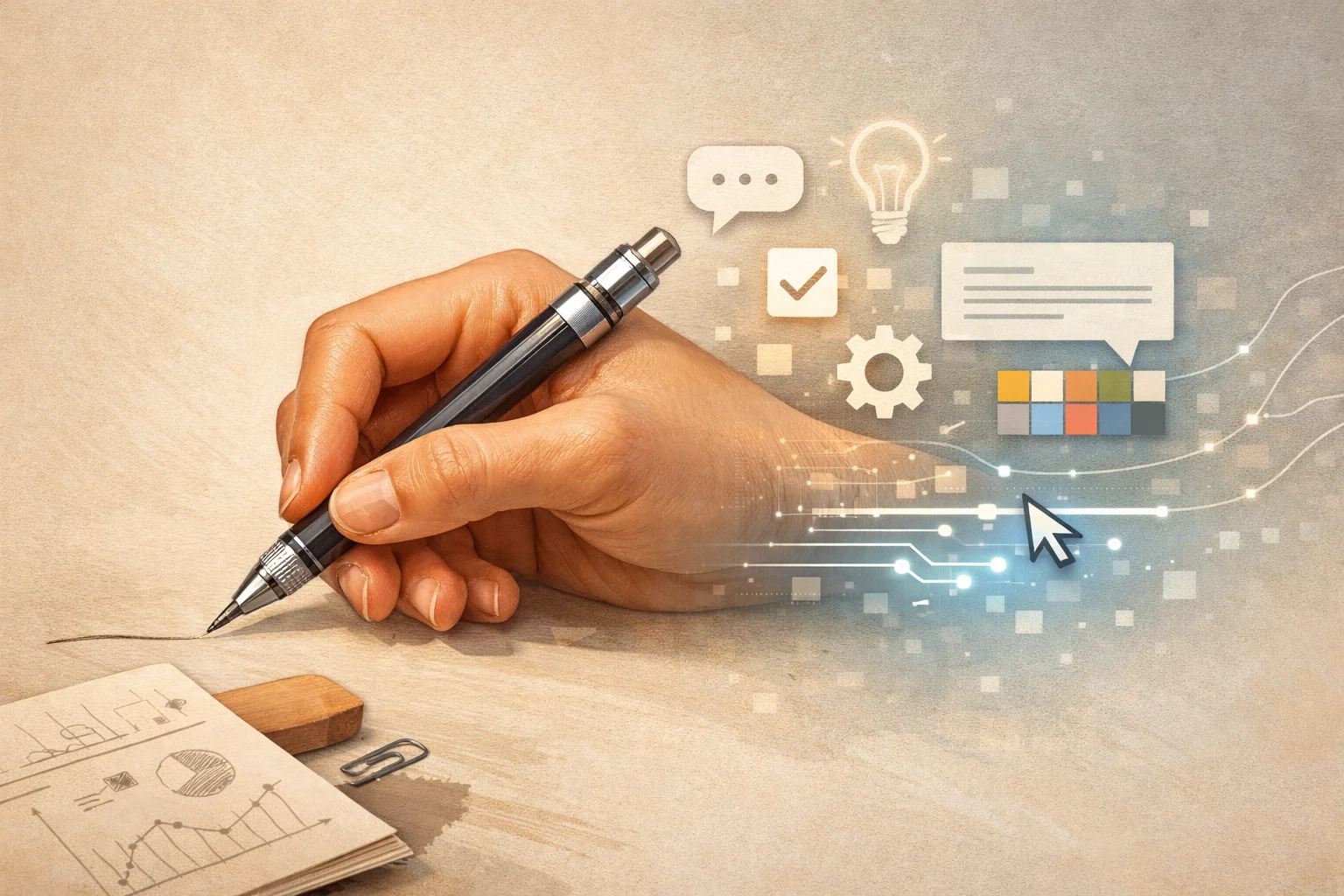
Instead, I want to explore how writing with AI can be approached thoughtfully—preserving the slow, messy art of thinking on the page, while harnessing AI as a helpful tool rather than a ghostwriter. In an age of shiny new AI-assisted writing platforms, it's more important than ever to clarify what part of the process remains fundamentally human.
After all, the real challenge isn't the tool itself, but how we choose to use it.
Writing as Thinking—Not as Output
When I write, I'm not simply producing content—I'm figuring out what I think. The act of writing is a form of slow, deliberate cognition. Historian David McCullough famously said:
"Writing is thinking. To write well is to think clearly. That's why it's so hard."
This rings true for me. My first drafts are often messy, winding explorations where I grapple with ideas. In those moments, I'm not worrying about output or polish; I'm engaging in what some call "writing as thinking"—using the page to clarify a foggy thought or to discover an insight I didn't know I had.
Crucially, making my writing readable is not the same as dumbing it down. Clarity doesn't equal oversimplification. In fact, achieving clarity can be intellectually rigorous—it forces me to confront the logic of my thoughts and the solidity of my evidence. A clearly written piece can still hold depth, nuance, and complexity; it simply delivers those qualities without unnecessary obscurity.
In a world flooded with bite-sized content and listicles, I've come to value slow thinking and depth. Polishing a sentence so that it's precise and comprehensible doesn't cheapen the thought—it strengthens it.
So my first conviction is this: The real thinking needs to happen before any AI comes into play. By the time I involve an AI in my writing process, I want to have wrestled with my ideas on my own. The heavy cognitive lifting—deciding what I believe and why—isn't something I want to offload to a machine.
After all, if I allow an algorithm to do all my thinking, then whose ideas am I really publishing?
AI as a Writing Tool—What It Can (and Can't) Do
When I do turn to an AI, I now approach it as exactly that—a tool in my writer's toolbox, not a replacement for my own thought process. Over time I've learned where AI shines in writing, and where its limits lie.
Where AI Helps
Structure Helper: If I'm juggling a jumble of points, an AI can suggest an outline or logical order that I might not have seen. It's like having an infinitely patient brainstorming partner to organize my scattered thoughts into a tentative shape.
Clarity Filter: When my phrasing is tangled up, I might ask an AI to rephrase a sentence more clearly, or to explain my own paragraph back to me in simpler terms. In doing so, I can spot where I was convoluted. The AI isn't coming up with new ideas here; it's helping me see if my existing ones are communicated plainly.
Language Enhancer: Perhaps my description is bland, and I want to add a touch of vividness, or I'm searching for that one perfect word that's on the tip of my tongue. AI can offer alternatives and variations, helping me refine the tone or elevate the diction if needed. I liken it to having a thesaurus or an editor on call, suggesting tweaks to strengthen my voice (so long as I choose among those tweaks judiciously).
The Critical Distinction
All these uses treat AI as an assistant—a means to assist writing, not to generate the core substance of the writing. This distinction is critical.
I consciously draw a line between AI-assisted writing and AI-generated thinking. The AI can shuffle my words or polish a sentence, but I don't ask it to come up with original arguments or personal insights. In other words, I don't expect the tool to generate the thought.
There's a reason for that boundary: anything that involves true insight, perspective, or creative risk needs to come from the writer. AI, no matter how advanced, works by predicting patterns from existing human writing. It remixes and regurgitates what others have said before. It cannot introspect on my behalf or suddenly produce a fresh idea that requires lived experience or a leap of intuition.
If I leaned on it for that, I'd just be ventriloquizing the aggregated internet.
AI can help clarify thoughts, but it can't create them. It doesn't "think"—it processes.
The actual thinking—the why behind the words—remains my job as the author. Keeping this distinction clear is, I believe, a key part of AI literacy for writers in the modern age.
My Writing Process with AI (Laid Bare)
To make this all less abstract, let me share how my writing process with AI currently works, step by step.
Phase 1: Raw Thoughts
It usually starts with raw thoughts—I'll have a notebook or document where I've dumped ideas, snippets of argument, quotes, anecdotes. It's gloriously unstructured and often quite chaotic. This is the pre-AI phase where I'm just exploring what I want to say.
Phase 2: Shaping the Chaos
Next comes the stage of shaping the chaos. I'll take those raw thoughts and begin imposing some order: maybe grouping related ideas, drawing connections, and sketching out a possible flow. Even here, I might feel a bit overwhelmed by the clutter (imagine index cards strewn across a table).
This is the point where I carefully bring in the AI as that "infinite patience" assistant. For instance, I might feed the AI a long, disorganized brain-dump and ask, "What themes do you see here? How could this be structured?"
The AI might respond with a tentative outline: "It sounds like you have three main sections..." or "These two points seem related...maybe combine them." This gives me a fresh perspective on my own mess. It's akin to having a second opinion from someone who isn't emotionally attached to any particular sentence.
But crucially, I treat this AI feedback as suggestion, not gospel. I remain in charge of deciding, "Yes, that structure makes sense," or "No, that suggestion doesn't fit what I truly want to say." AI is my collaborative editor at this stage—a very helpful one—but not the author.
Phase 3: Writing the Draft
Once I've organized my piece, I'll write a full draft in my own voice. Only after I have a draft that sounds like me will I use AI again, this time as a kind of virtual editor or proofreader.
I might ask it: "Is anything unclear or redundant in this draft?" or "Can you spot any logical gaps?" The AI might highlight a sentence that was confusing or a paragraph that felt out of place—things a human editor or critical friend might also catch. I find this incredibly useful for refining clarity and coherence.
Again, I get to decide which feedback to accept. Sometimes the AI is off-mark, but often it points out genuine weak spots or alternatives I consider improving.
Transparency as a Practice
Throughout this process, I strive to be transparent—at least with myself and often with my readers—about where AI had a hand. I consider AI a "second mind" I consulted, and I don't want to pretend otherwise.
In fact, I've found that openly acknowledging, "I ran this paragraph through an AI for style suggestions" or "The outline was fine-tuned with a bit of AI help," actually builds trust with readers. It signals that I have nothing to hide about my process.
Just as we might thank a human editor in an acknowledgments section, I see no shame in crediting the AI's role. This kind of openness is part of my personal ethics. By disclosing AI assistance, I'm implicitly assuring readers that the ideas and final decisions are still mine, even if a machine gave some technical aid.
In a time where many ask "Was this written by AI?", such transparency is a way to keep faith with the audience.
AI as Editor, Not as Author
One helpful way I frame this is: AI is my editor, not my author.
I often compare it to the relationship with a human editor or proofreader. A good human editor can transform a piece of writing—smoothing out clunky phrasing, correcting grammar, suggesting re-orderings, even querying the author where an argument seems weak. The end result reads more fluidly and hits harder.
Yet, after all that work, we still rightfully say we wrote it. The editor improved the expression, but didn't supply the substance.
I view AI in a similar vein. It can polish and tighten my prose, perhaps even in ways that feel like "smoothing my voice." But that doesn't automatically mean it's robbing the piece of soul or originality.
The Fear of Homogenization
I know there's a fear that using AI to "gloss" our language results in generic, soulless text—that any unique rough edges in style get sanded away to bland perfection. There is a risk of that if we lean too heavily on it.
However, smoothing is not automatically emptying. A clear, elegant sentence can still carry punch and personality. In fact, sometimes my original phrasing was not "quirky and authentic" as I might fondly believe, but just confusing or awkward! In those cases, letting the AI suggest a cleaner version elevates the impact of my idea without diluting my voice.
Keeping Stylistic Fingerprints
I keep a conscious eye on this: if a suggestion from the AI makes the sentence clearer but still true to what I meant, I take it. If it makes it sound generic or loses a personal flair I intended, I revert back to my phrasing.
There are places I intentionally do not let the AI smooth the text. For example, if I've written a sentence with a certain rhythm or alliteration that has personal meaning, I'll keep it even if the AI flags it as unusual. Those small stylistic fingerprints matter to me. The goal is not a sterile, machine-like consistency; it's coherence with character.
I liken this to working with a human copyeditor on a novel or essay. A seasoned editor might suggest cutting a peculiar metaphor or standardizing some dialogue—but a good author knows when to say, "No, I'm keeping that quirk because it's part of the voice or the narrative's integrity."
Using AI requires that same assertiveness from the writer. You are allowed to overrule the algorithm. In fact, you must when it conflicts with your intent.
By treating AI as a diligent but not infallible reader/editor, I maintain my role as the final author. The AI can propose, but I dispose.
Human Thinking vs. AI—Where the Boundary Really Lies
A critical question I ask myself is: at what point does using AI cross over from helpful support into problematic cognitive offloading?
Cognitive offloading, in this context, means turning over so much mental work to the machine that I'm no longer truly engaging my own critical faculties. As writers, we all outsource to some extent—even a spell-checker or grammar tool is a mild form of offloading. But there's a tipping point.
If I let the AI not only fix commas but also decide what I should write or why it matters, I'm in dangerous territory. That's the line I vigilantly monitor.
The Research on Cognitive Offloading
Studies and observations in the field back up this concern. According to research on cognitive offloading, people tend to reduce their effort when an external system reliably produces results for them. In other words, the more we trust the machine to deliver, the less our own brains stay fully engaged.
This resonates with what psychologists call automation bias—we can become complacent, assuming the system knows best. Generative AI ups that ante because it can produce whole paragraphs that look very confident.
If a user isn't careful, it's easy to accept those outputs uncritically and overestimate one's own contribution. As one analysis noted, when AI effectively replaces rather than supports a person's reasoning process, users report feeling like it was easier—unsurprisingly—but they also show reduced critical engagement with the task.
That's a caution flag for any writer.
My Self-Test
So I've devised a little self-test for my own writing to guard against this:
Before I use any significant AI-generated text or suggestion, I pause and ask: Could I explain this point in my own words without the AI's help?
If the answer is no—if I don't truly grasp or own what's being said—then inserting that text would be a red flag. It means the AI might be carrying the cognitive load for me, and I'm just passively transcribing. In such cases, I either delete the AI's contribution or I go back to first principles until I can articulate the idea myself.
Another self-check: Am I still actively making decisions at each step? If I ever find I'm just hitting "Accept, accept, accept" on AI suggestions without deliberation, I step away.
The goal is human-first writing—keeping my brain in the driver's seat and the AI in a supporting role.
The Temptation and Its Cost
Maintaining this boundary isn't always easy. AI tools are becoming very convenient, and sometimes when you're tired or on a tight deadline, it's tempting to let them do more. I've felt that temptation: "Why not have the AI draft this section? It'll be faster."
But whenever I've succumbed to that in the past, I ended up with writing that felt hollow. The section might have been factually fine and grammatically correct, but it lacked the subtle something that comes from genuine thought—that human signal in the AI era that lets a reader know a person is really behind the words.
That's what I never want to lose.
So the true boundary between human thinking and AI, for me, is an attitudinal one: it's the resolve that I am responsible for every idea and claim in this piece. No matter how much editing help or surface polish AI gives, I must ensure the piece reflects my mind, not an amalgamation of others' thoughts.
If I can hold that line, then I believe AI can be used without sacrificing my authorship.
Authorship in the AI Era Is an Attitude, Not a Tool Problem
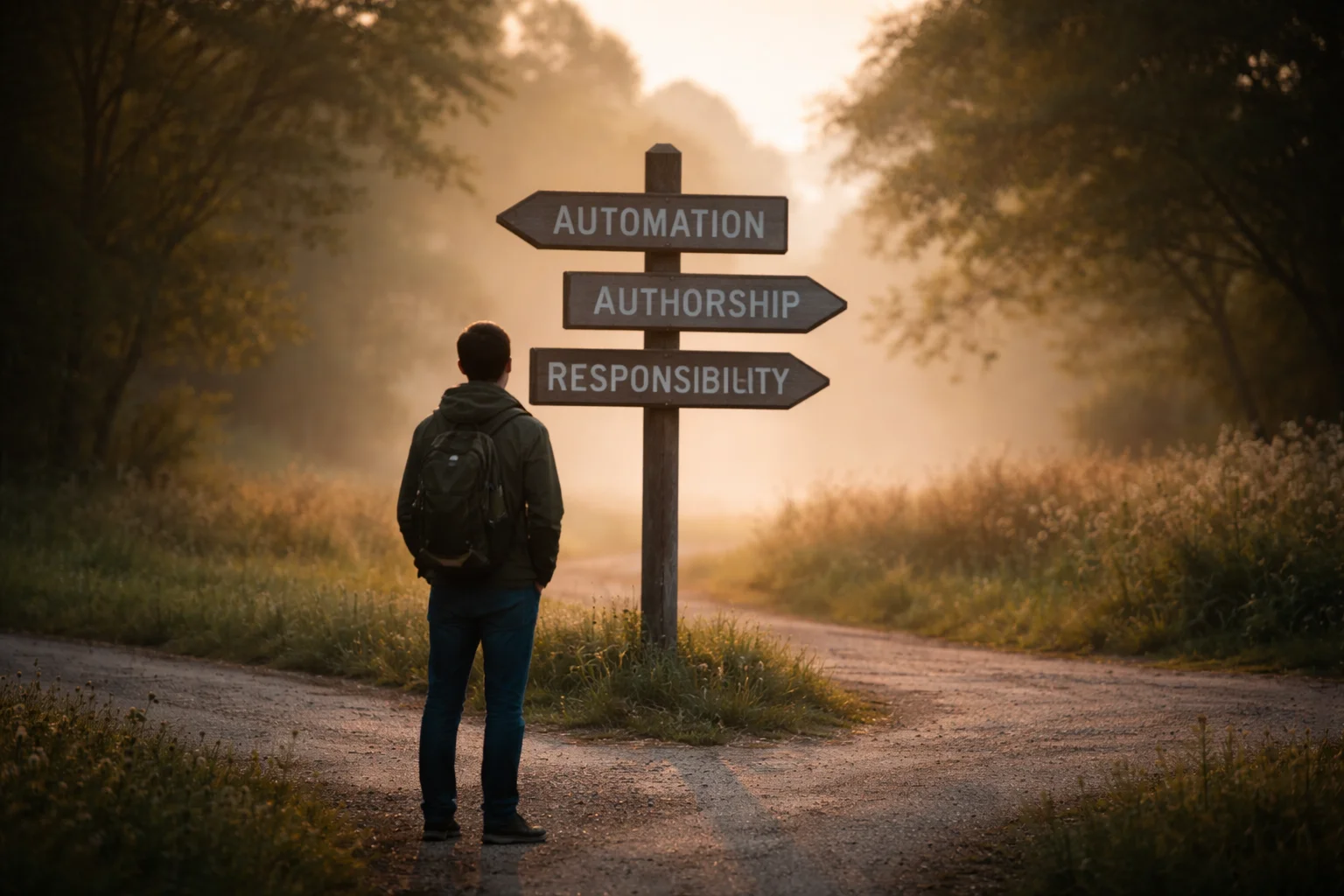
All this leads to a broader reflection on authorship. In the age of AI, I've come to see being an author not as a strictly technical act of who typed the words, but as a stance of responsibility and honesty.
Whether I use no AI, a little, or a lot, what ultimately matters is the integrity of my approach.
Avoiding the Extremes
It's easy to fall into one of two extremes: some people now joke "Oh, everything is basically AI-written these days, who cares," while others swing to "I'll never touch AI, it's corrupting writing."
In my view, "all AI" and "no AI" are both ways of avoiding the real issue. They're polar opposites that allow a person to dodge the nuanced work of using AI carefully.
If I said "I'll just let AI handle all my articles from now on," I'm essentially abdicating the core of authorship—which is accountability for the content.
If I stubbornly refuse any AI assistance even where it could help (say, catching typos or structuring ideas), I might claim a kind of purist moral high ground, but I could be missing out on a tool that, used ethically, makes my writing clearer or frees time for deeper thinking.
Neither extreme addresses the heart of the matter: how to incorporate new technology without losing our soul as writers.
Authorship as Ownership
I've come to realize that being an author in the AI era boils down to an attitude of ownership. It means saying: no matter what tools are involved, I own my words and their impact. It's a commitment to intellectual honesty.
If an AI helped generate an insight, I shouldn't pretend I came up with it alone—I either shouldn't be using that insight, or I should be transparent about how it arose. Likewise, I shouldn't blame the AI for any inaccuracies or clichés in the text; if it's published under my name, I am answerable for every bit of it.
This attitude also implies continual self-reflection. It's asking oneself, "Am I using this tool to enhance my work, or to escape my responsibility to do the work?"
For example:
Using AI to check facts or grammar is enhancing
Using it to fabricate entire sections I'm too lazy to research—that slips into irresponsible
Authorship in the AI age requires a kind of steadfastness. I have to remain engaged and not let the convenience turn into a crutch. It's similar to the idea of intellectual ethics—being truthful not just in avoiding plagiarism, but truthful to one's own thought process.
I suspect in the future we'll even develop a sort of writer's code of conduct around this, but for now it's personal. Each writer has to set their comfort level and moral line.
My stance is that authorship is a human responsibility. Tools can assist creativity and expression, but they don't take on the responsibility for truth, originality, or impact—the human does.
So I choose methods that keep me in a responsible position. That's why I neither blindly automate everything nor fetishize writing with a quill pen by candlelight. The method (digital, AI-involved or analog) is secondary; the guiding principle is what counts.
And my principle is maintaining a human heart and mind at the core of everything I write.
AI and Creativity—Amplifier or Diluter?
One big concern many writers have is how AI will affect our creativity. Does it act as a booster, providing inspiration and amplifying our originality? Or does it water everything down to a bland sameness, diluting the creative spark?
I've experienced a bit of both, and I believe the outcome depends largely on how we wield the tool.
AI as Creativity Amplifier
In some ways, AI can certainly be a creativity amplifier:
Breaking Through Blocks: When I'm stuck with writer's block or I need a fresh angle on a topic, I can brainstorm with an AI: "Give me 5 quirky metaphors about X," or "What are some unusual perspectives on Y?" The results are often off-the-wall and occasionally brilliant. They might include ideas I never would have considered. This can jog me out of conventional thinking and spur new creative connections.
Handling the Legwork: AI can also handle some legwork that frees me up for creative thinking—summarizing research, translating a chunk of text, checking consistency. By saving time on these routine tasks, I can spend more time in the imaginative realm, playing with concepts and language.
Rapid Ideation: Many have described AI as a "thought partner"—not because it truly thinks originally, but because it reacts in realtime to your prompts, enabling a kind of rapid-fire ideation session. When used this way, it augments the creative process. I remain the director, but I've got an always-on creative assistant to riff with.
The Dilution Risk
However, there's a flip side. If relied on uncritically, AI can indeed become a creativity diluter. Why?
Because it's designed to predict patterns based on existing data. It will often steer you toward the average expression or the most common stylistic choice. If I ask it to continue a story in my style, for example, it might produce something pretty good—but often it reads a bit generic, as if imitating many writers at once.
The risk is that my unique voice could get averaged out. True originality often involves taking a risk: perhaps breaking a rule of grammar for effect, or introducing an odd metaphor that initially doesn't "fit." AI, by its nature, is less likely to do that unless explicitly guided, because it's trained to sound plausible and on-pattern.
Over-relying on it can lead to a certain sameness. I've noticed this when reading a lot of AI-generated content online—it's fluent and correct, but there's a certain homogeneous tone that eventually emerges, a lack of bold personality.
Where Originality Lives
But I'd argue originality doesn't live in our polished style alone; originality lives in our ideas and perspectives. My "voice" as a writer is not just the adjectives I choose or the cadence of my sentences—it's the worldview, the insight, the mental fingerprints behind those words.
AI can't replicate the life experiences or the intuitive leaps that inform genuine creative thought. It might fake the outer style, but it can't truly originate a new lens on the world.
So if I ensure that before any AI touches the text, I have injected me—my odd questions, my emotional take, my unusual angle—then that human creativity anchors the piece. The voice emerges before the form.
Preserving Creative Friction
In practice, this means I often sketch out creative ideas longhand or in a separate doc without AI, to let my mind roam. Only later, when I've settled on a direction that feels authentically mine, will I let AI perhaps assist in fine-tuning the form. This way the core remains personal.
I also intentionally embrace risk, friction, and even a bit of messiness as markers of creativity. Not every sentence has to be perfectly smooth. Sometimes a slightly jagged, peculiar phrasing can make a reader sit up and feel something. If AI tries to iron out every wrinkle, I re-introduce some texture.
A creative piece benefits from a bit of rough edge—it shows there's a human pushing boundaries here, not just a machine optimizing for engagement.
I recall a moment in one of my essays where I left a metaphor that the AI suggested changing. It wasn't a standard metaphor; it was weird and maybe a little unclear, but it felt right for the emotion I was conveying. Keeping it was a conscious choice to preserve that creative friction.
Many great works have that one strange element that shouldn't work but does—precisely because it's fresh.
So in balancing AI and creativity, I treat the AI's suggestions as conventional wisdom and my own impulses as the potential innovation. I use the AI to amplify execution (make the language sing where I want it to), but not to decide the soul of the piece.
That way, AI becomes a creative amplifier under my direction, and I minimize the diluting effect.
Writing Ethics: What I Owe to Myself (and My Readers)
All these reflections tie into a personal code of writing ethics I've been developing for myself. I realized that using AI in writing isn't just a technical or stylistic choice—it's an ethical one, in the sense that it touches on honesty, authenticity, and responsibility.
What do I, as a writer, owe myself in this process? And what do I owe my readers?
I don't have a formal rulebook (and I'm wary of anyone who claims to have one, given how new this territory is), but I have some guiding principles—personal guardrails—that I try to follow.
What I Owe Myself
Honesty about my intentions: If I ever catch myself using AI to cut corners in a way that makes me uneasy, I confront that. For example, if I'm tempted to have the AI generate filler text just to hit a word count, I ask, "Why am I doing that?" If the honest answer is that I have nothing more to say but I want the article longer, then the ethical move is to stop and rethink the content, not to pad it with AI-generated fluff.
Skill preservation: Relying on AI shouldn't become an excuse to let my own writing muscles atrophy. If anything, I try to use AI in ways that teach me—like noticing how it rephrased something clearly and learning from that—rather than just doing it for me. That's part of an ethic of critical use of AI: use it in ways that make me a better writer, not a lazier one.
What I Owe My Readers
Something real: Readers give us their time and attention (precious commodities in the modern attention economy), and in return they expect a human touch—an insight, a perspective, a story that only I could tell. If my article ends up feeling like any generic blog post, I've let them down.
So I have a sort of pact with the reader: I'll strive to give you me, my genuine thought, packaged as clearly and engagingly as I can. If AI helped me clean it up, I'm okay with that, because the thought and voice remain sincere.
But I would feel guilty if I served them something that was basically auto-generated drivel with minimal effort or personal input. Part of writing ethically with AI is ensuring the end product still carries a human signal amid the noise—that there's a human being's care and effort evident in the writing.
The Question of Disclosure
I've also considered the question of disclosure. Do I explicitly tell readers when AI was involved?
In academic or journalistic contexts, perhaps we'll see formal policies on this. On my personal blog, I sometimes do mention it if it feels relevant (like "I ran this post through Grammarly" or "An AI helped tidy up the language here"). Other times I don't highlight it if the use was mundane (like spell-check or minor grammar fixes)—similar to how I don't normally announce "I used a dictionary and Google in writing this."
But the ethic behind it is: never deceive the reader about the nature of the writing. For example, I would never present an AI-generated story as my own autobiographical experience—that's a clear line. Nor would I quote an AI's analysis as if it were a human expert's opinion. Those kinds of misrepresentation are where AI use becomes unethical.
The reader trusts me not to mislead them, and that trust is sacred.
My Personal Guardrails
In essence, the ethic I hold myself to is one of transparency and accountability:
Use AI, but don't abuse it
Enhance clarity, but don't erase authenticity
Be efficient, but not at the cost of original thought
Always be ready to take responsibility for what I publish, as if no AI existed at all
This way, I can look in the mirror (or at the screen) and feel I haven't cheated myself out of the genuine growth that comes with writing, nor cheated my audience out of the genuine voice they came to read.
Conclusion: Writing Despite AI—Slower, More Conscious, More Human
Living and writing in this post-AI world, I've arrived at a somewhat paradoxical mindset: I embrace the new tools, yet I'm writing slower and more deliberately than I ever did before. And that's by choice.
It's easy to imagine a future where writing becomes a push-button activity—"generate me an essay on X"—and perhaps for some utilitarian texts, that's fine. But for the kind of personal, reflective, long-form essays I care about, I believe the value will increasingly lie in the human-ness of them.
In a digital era racing ahead with automation and cognitive offloading, deliberately slowing down to infuse thought and care into writing is almost a rebellious act.
I'm not saying goodbye to technology (I'm typing this on a laptop, after all, with AI tools at arm's reach). Nor am I retreating to an analog typewriter in a cabin (though the romantic in me smiles at that image).
Instead, I'm advocating for writing as a conscious act in a world that's accelerating.
Using AI doesn't mean saying farewell to our own words, and using our own brain doesn't mean rejecting modern tools. The two can co-exist.
I continue to write despite AI's ability to write for me—because the process of writing itself, the thinking and grappling and phrasing, has inherent value. It keeps me connected to my intellect and imagination in ways no shortcut can replicate.
In an attention economy that rewards speed and volume, choosing to write mindfully—to sometimes write slower—is how I ensure there's a human voice behind each line. It's my way of standing out from the algorithmic chorus with something hopefully resonant and real.
At the end of the day, what comforts me is this: readers are human, and humans resonate with humanity.
If my writing carries that signal—of authenticity, of a mind revealing itself—it will find its audience, even amid AI-generated content glut.
So I write on, a bit more slowly, a lot more consciously, and proudly more human, using AI as a helpful aide but never a replacement for the thinking, feeling writer behind the screen.
In doing so, I hope to contribute writing that isn't just technically correct or SEO-optimized, but writing that means something in this dizzying digital age.
After all, if we all maintain that commitment to thoughtful, human-first writing, then no matter how smart our tools get, the essence of writing with AI will remain us—the authors—at the helm, signaling to other minds out there:
I'm here, I'm thinking, and I have something uniquely human to share.
AI & Automation
Claude Cowork: When AI Programs Itself – Revolution or Hype?