“We'll just build it ourselves.” Anyone who runs a company knows that sentence. It used to end in an Excel list. Today an AI builds an app with a customer database over a weekend, and it looks great.
With an app like that, you're never alone at work. In May 2026 a security firm searched apps made with AI app builders: 1 in 76 exposed sensitive data on the open web. Anyone who wanted to could read along. Including the people who really shouldn't: strangers, competitors, scammers who make their money with names and email addresses.
I'm building software with AI myself right now, an entire office suite, and wrote about it on LinkedIn. Which raises a question that often gets lost in the excitement: how secure is what everyone is building with AI right now?
The short answer
- Many AI apps are Excel lists that moved house. The list used to sit as a file on the company network. Now it sits in a database on the internet. Whether anyone reads along depends on a single setting.
- The AI isn't the problem. It builds what the app builders tell it to: a central database. That database is the target.
- Balane Office doesn't have one. Files stay on your device, even though the whole office suite was built with AI.
- Security isn't everything. Maintaining, being liable and reporting still takes a person. That's why Balane Office is an experiment, not a product.
The Excel list becomes an app
“Excel is dead. Build yourself an app.” That's the promise of vibe coding: you describe to an AI what you want, and it builds it. Platforms like Lovable, Replit or Base44 turn that into a product. One sentence in, one app out, with login, database and its own address on the web.
In May 2026 the Israeli security firm RedAccess looked at what comes out of this. It found 380,000 publicly reachable apps and databases from Lovable, Replit, Base44 and Netlify. Around 5,000 of them contained sensitive data, roughly 1 in 76. Axios and Wired verified some of the cases.
What was inside reads like a look into other people's Excel files. Which ships are expected in which port and when. A list of ongoing clinical trials. Customer service chat logs. Financial figures from a bank. Medical reports from hospitals.
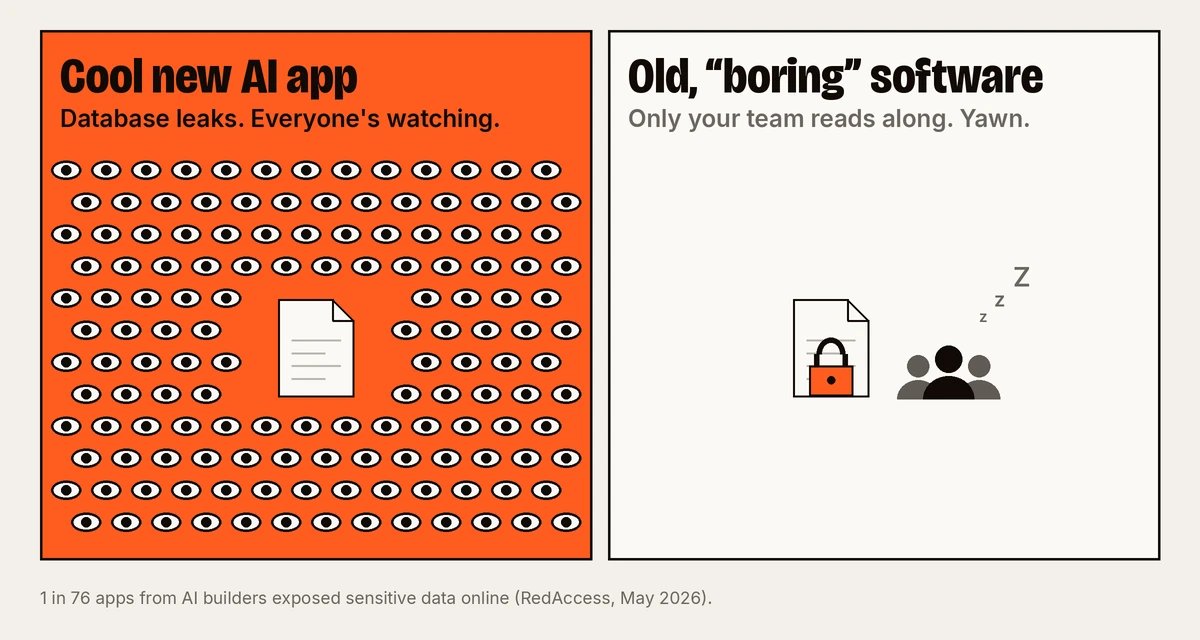
A list like that used to sit as a file on the company network. Anyone who wanted to read it had to get in first. Today it sits in a database on the internet, reachable around the clock.
How exposed are AI apps really?
A second count comes from UpGuard, another security firm. In October 2026 it examined around 300,000 websites that use Supabase, an online database that according to UpGuard is close to the default for vibe-coded apps. On 16,326 of them anyone could read tables, and more than half contained signs of personal data.*
UpGuard, October 2026; RedAccess, May 2026. The two studies count different things and can't be added up. * See the note at the end.
The cause is mundane. To keep strangers out of other people's records, every table needs a rule saying who may see what. When a person creates the table in the dashboard, that rule is switched on. When an AI agent creates it through the API, it isn't. And UpGuard didn't check its 300,000 websites by hand, it did so automatically. What researchers can do, attackers can do too.
The AI isn't the problem
You could conclude: hands off AI. That would be the wrong conclusion.
In all these cases the AI built what it was told to, or what the platform nudged it towards: an app with a central database on the web. That's how web software has been built for twenty years. The only new thing is that anyone can now do it, overnight, without knowing that this one rule exists.
Whoever uses AI to turn an Excel list into a web app swaps a file on the company network for a database on the internet that anyone can read if a single rule is missing.
Why Balane Office has no database
I'm building Balane Office the other way round from the start. Spreadsheets, documents and presentations are files on your device, just like an Excel file. There's no account and no server where I collect anything. Where AI helps, the text goes directly to the provider you chose, with your own key.
What you don't collect, you can't lose.
That doesn't make everything secure. A lost laptop is still a lost laptop, and anyone using AI sends text to a provider. But an open database can't happen in Balane Office, because there's no place where it could sit.
The objection: Excel files aren't secure either
The obvious objection to my file-based approach: Excel files travel the world as attachments, end up in the wrong folders and on USB sticks. That isn't secure either.
True. But then a leak affects one file, not a database that anyone on the internet can query, around the clock, automatically.
The second objection is more serious: no central database, no collaboration. I'm working on that right now. Balane Office is getting a team chat and shared document editing where devices talk to each other directly, end-to-end encrypted. Whether that holds up in a real team's daily work is still open. That'll be its own episode.
What no database doesn't solve
Under my LinkedIn post, Sergey Goncharenko, a program manager in enterprise IT, pushed back, explicitly as a private person. One of his points fits right here:
“People working with your office need to trust nothing bad is embedded in a macro. And I am not talking even about hackers now, nowadays it could be AI agentic swarms.”
He's right, and the numbers above show it: UpGuard searched 300,000 websites automatically, and attackers can do the same. Where there's no central database, there's less for a swarm to graze. But that doesn't program trust. Trust is built over years, through audits and through someone who is liable.
Sergey raised more, mainly on maintenance and compliance. There, too, he's largely right. For 16 deliberately chosen building blocks, my team chat pulls in around 600 packages, and a tiny update broke the iPhone build. And if an app loses personal data, a person has to report it: within 72 hours under the GDPR. For products offered to others, since 11 September 2026 the Cyber Resilience Act also applies: report an exploited vulnerability within 24 hours. Nobody cares that the code came from an AI. Those objections will get their own episode.
What follows
BEFORE YOU TURN AN EXCEL LIST INTO AN AI APP
- Does this list really need a database on the internet? Often a file is enough.
- If yes: who may see which data, and has anyone tried it as a stranger?
- Who raises the alarm when something breaks? A name, not a department.
I keep building and write down what works and what doesn't. Next up: the team chat without a server, and what maintenance and compliance mean for self-built software. You can try Balane Office at balane.online, and if you want to see where it goes, follow me on LinkedIn.
Which Excel list in your company has already become an AI app, and do you know who's reading along?
* The 16,326 are Supabase databases with publicly readable tables, counted by UpGuard across around 300,000 websites (published 14 October 2026). According to UpGuard, Supabase is close to the default database for vibe-coded apps. UpGuard didn't count how many of the 16,326 were demonstrably built with AI, and whether strangers actually accessed the data is not established. Clearly attributable to AI app builders are the around 5,000 apps from the RedAccess study.
Related
- Is AI eating its own makers? I rebuilt Office
- Why doesn't a company just build its own Office?
- The Certificate Was Valid
Sources
- VentureBeat: 5,000 vibe-coded apps just proved shadow AI is the new S3 bucket crisis, 8 May 2026, on the RedAccess study; verified by Axios and Wired
- UpGuard, Greg Pollock: Everything, Everywhere: Systemic Data Exposure in Supabase Apps, 14 October 2026
- Sergey Goncharenko, comments under my LinkedIn post, October 2026, personal opinion, quoted with his permission
- Regulation (EU) 2016/679 (GDPR), EUR-Lex, Art. 33 (notification within 72 hours)
- Jones Day: EU Cyber Resilience Act: 24-Hour Reporting Duties Start September 11, 2026, July 2026
- Regulation (EU) 2024/2847 (Cyber Resilience Act), EUR-Lex
- Own count: dependencies in the networking part of Balane Dialog (Cargo.lock and pubspec.lock), 18 October 2026; findings in
docs/product/erkundung.mdin the Balane Office repository