There is something deeply comforting about success. Not success itself. The explanation of it. Success, taken raw, is almost unbearable: it arrives without reasons, and a thing without reasons is a small form of vertigo. So the moment someone wins, we do what human beings have always done in the presence of the inexplicable. We reach for a story.
This essay is not really about AI. It is about people, and about a very old habit of building simple causal stories, after the fact, out of complex and contingent events. AI is only the clearest mirror we have ever built for it.
The thesis: Success creates explanations faster than explanations create success. We mistake the description of a single victor for a theory of victory, and we mistake hindsight for foresight.
I. The Comfort of an Explanation
Steve Jobs won because of design. Bezos won because he thought in decades while everyone around him thought in quarters. Zuckerberg won because he understood that people are held in place by other people. Musk won because he reasoned from first principles. NVIDIA won because it saw, earlier than the rest of us, that the future would be measured in compute.
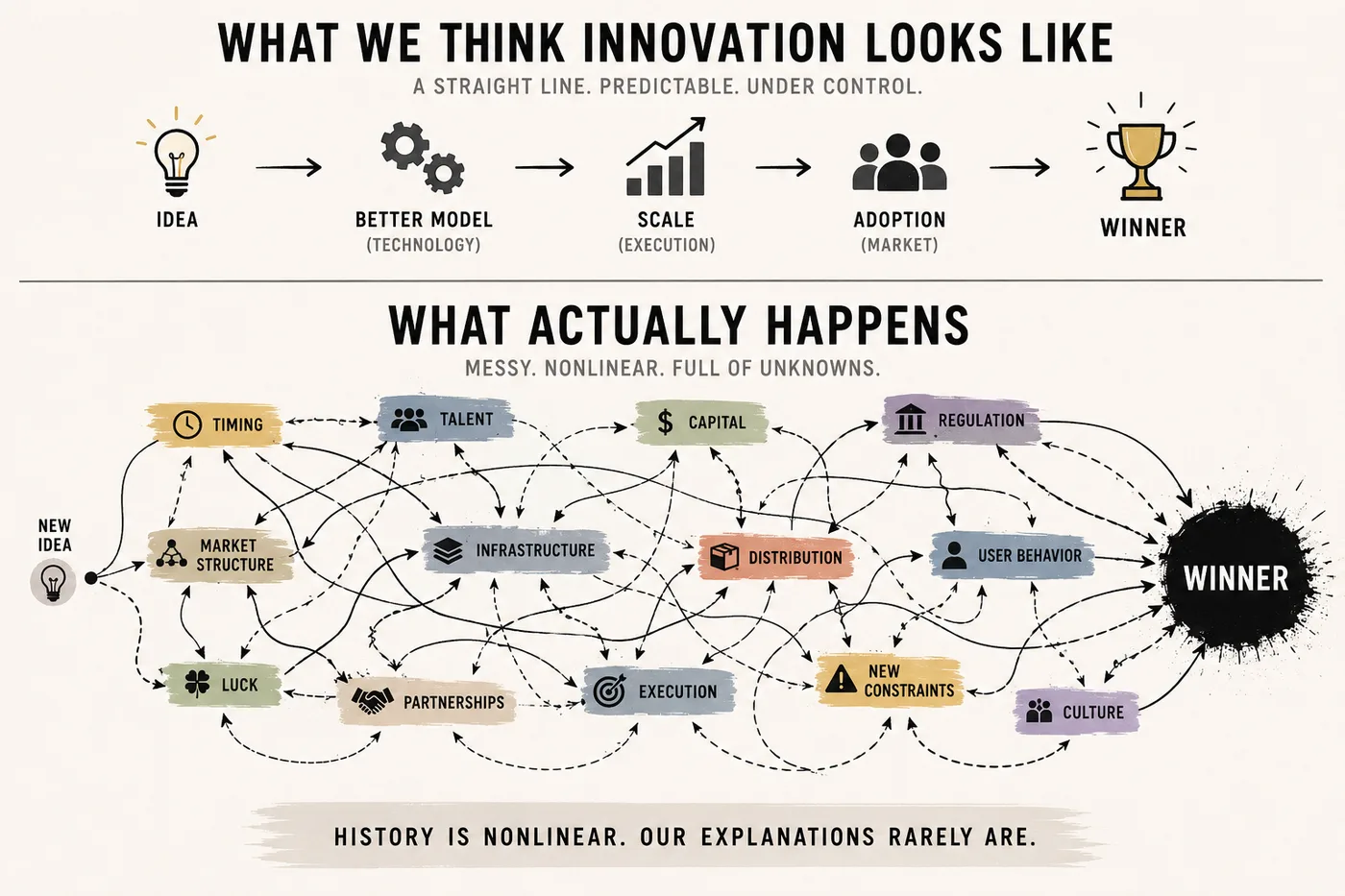
The stories are elegant. They have the clean geometry of things that are true. And they share one quiet property that almost nobody stops to notice: every single one of them was written after we already knew who had won. We rarely ask whether the explanation produced the success or whether the success produced the explanation.
II. The Archaeology of Success
Trace the last thirty years of technology and you will find the same ritual performed again and again. Microsoft. Google. Facebook. Amazon. Tesla. NVIDIA. In each case, the world eventually arrived at the same verdict, delivered with the confidence of a law of physics: the reason they won was obvious.
But obvious to whom? And obvious when? It was not obvious in 1998 that the twentieth search engine would be the one that mattered. It was not obvious that a company selling books below cost would one day sit underneath half the internet. It was not obvious that a social network built for college students would outlive every rival that reached the party first.
Obviousness, it turns out, is not a property of the past. It is a property of our position relative to the past. We are standing at the end of the story, and from the end, every turn in the road looks as though it were always leading here. History is written by the survivors, and business strategy, too often, is written by people studying only the survivors, mistaking the residue of a single outcome for the logic of all the outcomes that might have been.
III. The Graveyard Nobody Studies
We study Google. We almost never study AltaVista, or Yahoo, or Ask Jeeves, or Dogpile. We study Facebook. We rarely linger over MySpace, Friendster, Orkut. Or, for that matter, Google's own expensive attempt to will a social network into being. Not because the dead are unimportant, but because they are quiet. They stopped producing headlines, case studies, keynote slides. They fell out of the conversation, and then out of memory.
This is where the distortion enters. Not loudly, but structurally. When you study only the winners, you are not studying success. You are studying survival. You are examining the single reality that happened to remain, and treating the thousand realities that were every bit as plausible as though they had never been possible at all.
The graveyard holds most of the information. It is full of companies that did almost everything the winners did and lost anyway; full of the counterexamples that would puncture half our confident theories, if only we walked through it. We don't. It is more comforting to believe the survivors survived for a reason, that the reason is knowable, and that knowing it makes us wise.
IV. Technology Doesn't Repeat. Narratives Do.
Now look at what actually recurs. The technologies don't. Each wave is genuinely new: new physics, new economics, new constraints. What repeats is the shape of the story we tell about them.
In the nineties, the moat was distribution. In the two-thousands, it was search. In the twenty-tens, it was network effects. And each time, with complete sincerity, someone stood up and announced: this is the real moat, the one that lasts. Not because it was true in general, but because it happened to describe the company that was winning at that moment.
That is the whole mechanism, and once you see it you cannot unsee it. We take the specific traits of the current winner and quietly promote them into universal laws. The winner has distribution, so distribution becomes destiny. The winner has network effects, so network effects become gravity. We mistake the description of one victor for a theory of victory.
V. AI Is Not Different. We're Just Faster.
Which brings us, at last, to the present. I have waited until now to say the word on purpose. Watch how quickly the law of nature has changed in the space of a few years. First the moat was foundation models. Then it was open source. Then compute. Then reasoning. Then agents. Then memory. Then enterprise distribution. Then trust. Every few months, a new inevitability; every few months, someone explaining, calmly and persuasively, that this, finally, is the thing that decides everything.
Ask why the answer keeps changing. Not because we understand more with each passing quarter; if anything we understand less than we believe. The answer changes because the leader changes. And every new leader arrives carrying its own set of traits, which we promptly elevate into the secret of the age. AI has not broken the pattern. It has only compressed it. The narrative cycle that once took a decade now runs in a single season.
VI. The Illusion of Prediction
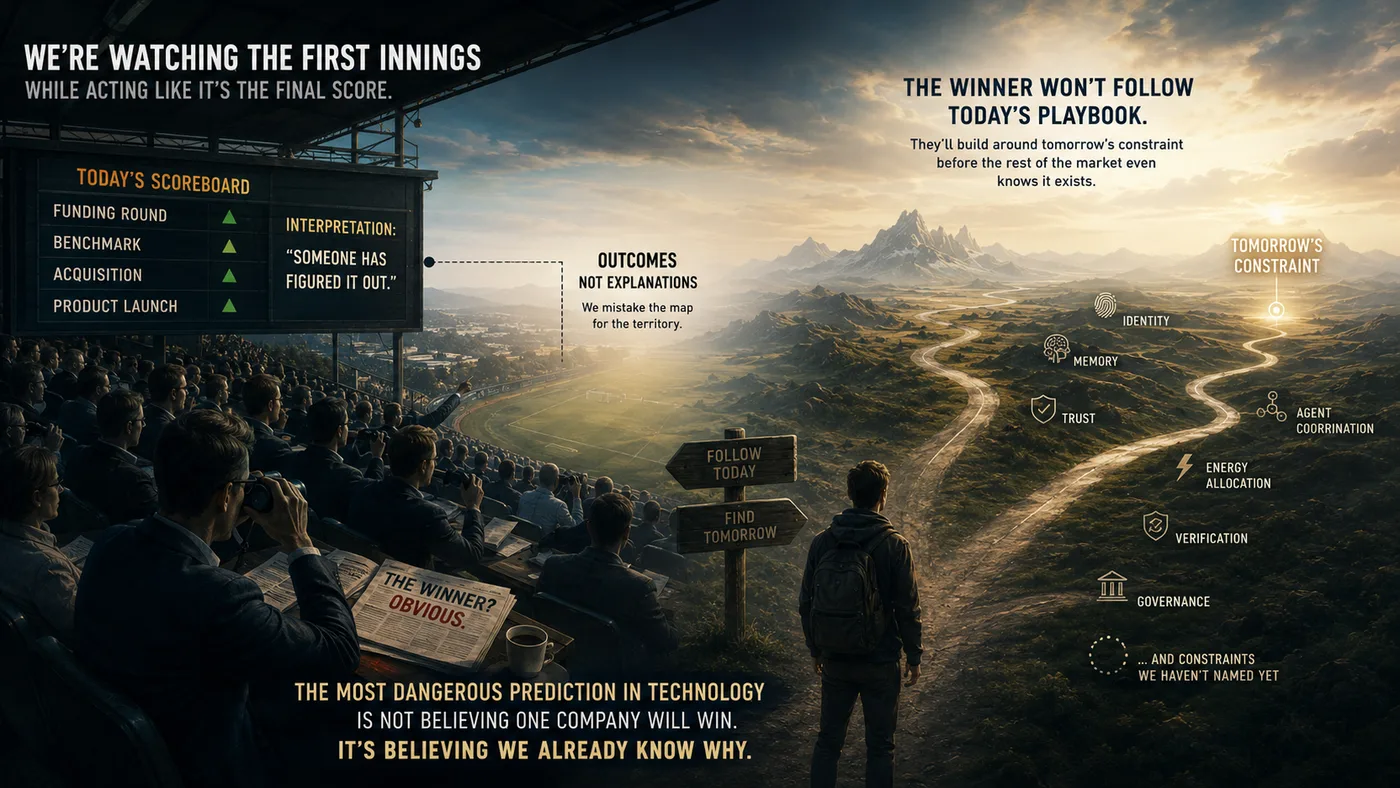
Underneath all of this sits a confusion we almost never name. We believe we are making predictions. For the most part, we are rationalizing the past.
A prediction is a claim about a future we cannot yet see. A rationalization is a story about a present we already can. From the inside they feel identical, both arrive as confident sentences about how the world works. Yet they point in opposite directions in time. Most investment theses, most strategy decks, most self-assured essays about who will win AI are not models of the future at all. They are stories about the recent past, wearing the costume of foresight. That is exactly why they are so persuasive. And exactly why they are so often wrong.
VII. What Actually Changes
Here is the turn. The mistake is not that we keep backing the wrong winner. Sometimes we back the right one. The deeper mistake is the assumption underneath the entire exercise: that somewhere there exists a universal reason winners emerge, a formula that, once found, would let us do it again.
What if there isn't? What if market leaders are not the output of a repeatable law, but the product of a specific, unrepeatable collision of timing, regulation, talent, capital, infrastructure, culture, luck, and ten thousand micro-decisions that will never line up in that exact configuration again? If that is true, then studying winners does not hand us a formula. It hands us a collection of beautiful stories about arrangements of the world that have already dissolved.
VIII. The Invisible Bottleneck
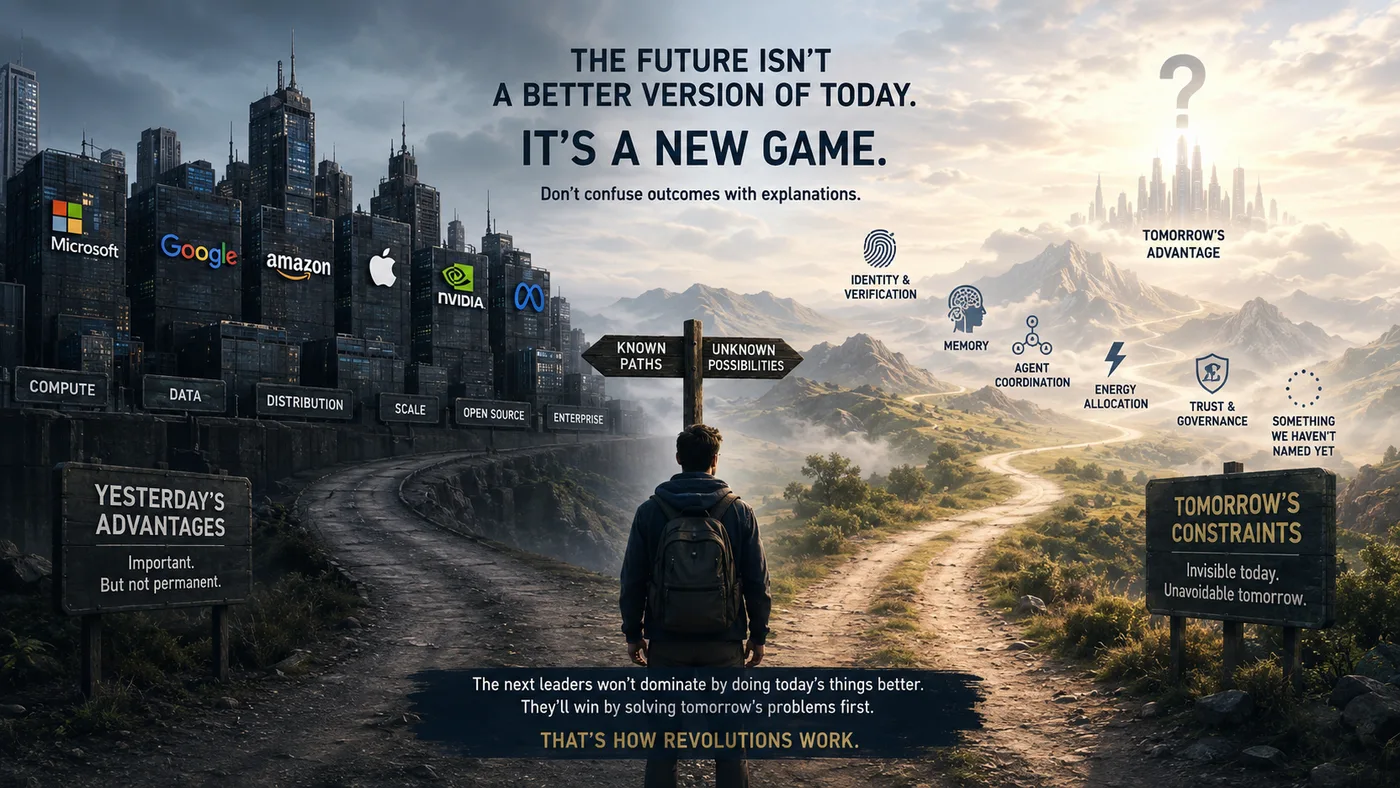
And if that is true, we have been asking the wrong question all along. Not who wins AI? but: which bottleneck are we not even looking at yet?
In 2005, almost no one was talking about Stripe, or Cloudflare, or Snowflake, or Datadog. They solved problems that barely registered as strategic at the time: the plumbing, the boring layers, the things nobody built keynotes around. And precisely because nobody was looking there, that is where enormous value quietly accumulated. There is a fair chance the same thing is happening right now, in plain sight. The trillion-dollar company of the next cycle may already exist; we may have already read its name and forgotten it. Not out of carelessness, but because we are searching for the wrong pattern, transfixed by the layer the last winner made famous while the next one grows in a layer we have not yet learned to see.
IX. The Most Dangerous Sentence in Technology
So let me end quietly, rather than dramatically. Everyone is asking who will win AI. Almost nobody is asking why we are so certain we already understand what winning looks like.
Every technological revolution produces new companies. But it produces something else as well, something that never shows up on a balance sheet: the comforting illusion that, this time, we have finally understood success. We like to believe history leaves instructions, that if we study yesterday's winners carefully enough, tomorrow's will become obvious. Perhaps it offers something far less comforting. Not instructions. Warnings.
Every generation mistakes survival for inevitability. Every generation mistakes explanation for prediction. Every generation believes it has finally found the formula.
Technology rarely repeats itself. Our narratives always do.