Germany goes out of the World Cup against Paraguay. On penalties, in the round of 32. And before the players have reached the dressing room, the diagnosis is in: this isn't about football. It's about the country.
The missed penalty becomes a mentality. The mentality becomes weak growth, poor PISA scores, late trains, sluggish bureaucracy. Suddenly everything hangs together: the team that explains why it should have won is the same country that explains instead of delivering. A defeat on penalties turns into the symbol of an entire condition.
The video is by Constantin Schreiber, a former anchor of Germany's flagship news broadcast, and it is rhetorically brilliant. A clear through-line, memorable phrasing, a clean arc from the scoreboard to the debate about Germany as a place to do business. As a YouTube video it works beautifully.
And that is exactly what makes it a perfect specimen. Not because it's wrong — in parts it's probably right. But because you can watch, in real time, how quickly and how convincingly the mind builds a closed explanation of the world from a single event.
The interesting question isn't: Is Schreiber right? It's: Why does his explanation feel so compelling — and what would have to be true for it to be more than a feeling?
This isn't an attack on his opinion. It's a look at the move behind it — the same move I notice least in myself.
A coin flip becomes a diagnosis
Start with the event everything rests on. A single knockout match is one of the lowest-information signals football has. A penalty shootout is the extreme case of that.
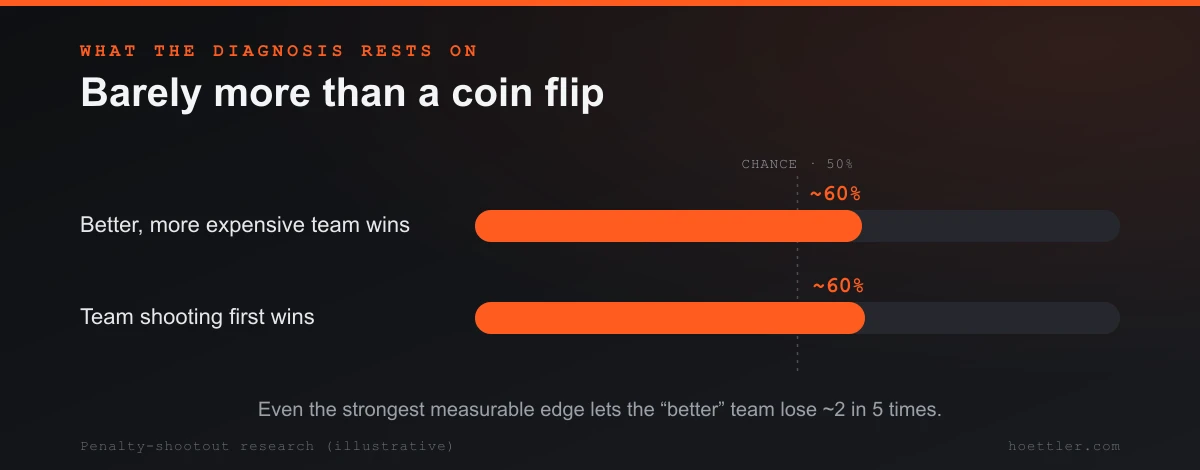
This explicitly does not mean "pure luck" — the opposite exaggeration would be just as wrong. The research paints a sober picture: skill and nerve matter measurably, but the edge they give is small. The favored, more expensive team wins the shootout on the order of 60 percent of the time, the side that shoots first has an advantage of similar size, and one study asks in its very title whether a shootout is even better than a coin toss. Translated: even with the strongest measurable edge, the "better" team loses roughly two times in five.
That's not an argument against football. It's an argument against the burden of proof we place on it. From an event this noisy you can barely infer which team was better — let alone the condition of a country of 80 million people. And yet this one data point carries the entire chain of reasoning in the video.
It's the same move I described in the market commentators: after the event, there is always a reason. Before it, almost never. The reason exists because the outcome is already fixed — which is exactly why it always fits.
Why the story feels so true
Our mind can't stand a random sequence. It lays a chain of causes over any run of events, because a world with reasons is easier to bear than a world with chance. Nassim Taleb calls this the narrative fallacy. The insidious thing isn't that the resulting story looks crude — quite the opposite. It's elegant. And we reliably mistake elegance for truth.
Two moves make the story so airtight:
The first is compression to a single cause. Economy, education, railway, permits, football — very different systems get one common denominator: "mentality." That sounds intuitive, but correlated declines are not a shared cause. Weak growth has different causes than poor maths scores; the late train, different ones than founder culture. Demographics, energy prices, institutions, capital markets, incentive systems — those are five different machines, not one. Draping a single "mentality" over all of them is narratively satisfying and analytically almost always too cheap.
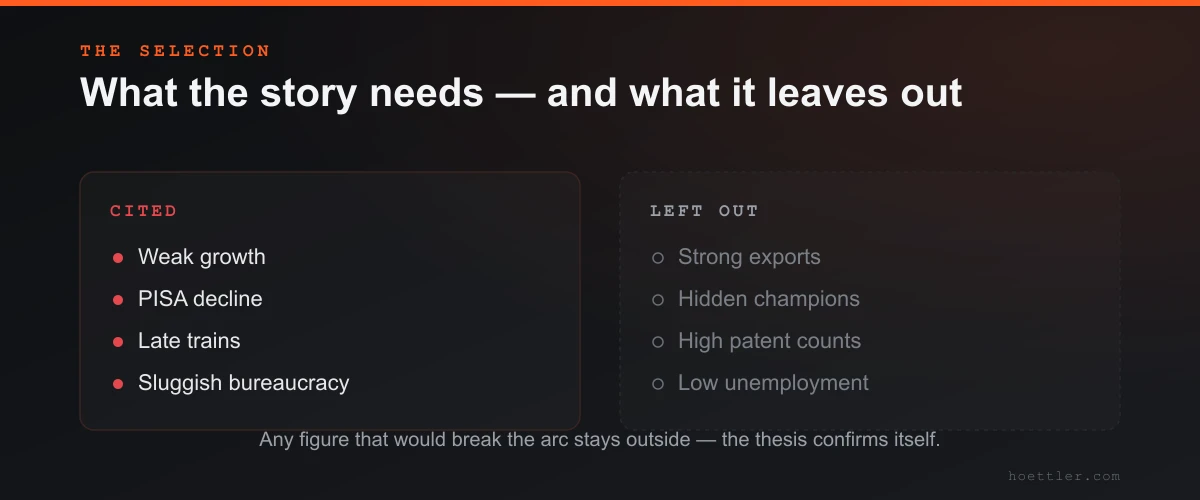
The second move is selection. Almost only negative indicators appear in the video. Left out: Germany's still-enormous export performance, its hidden champions, its high patent counts, its internationally low unemployment. That doesn't mean everything is fine. But any figure that would break the arc stays outside. What remains is a thesis that confirms itself, because it only invites its own evidence.
A story can be logical, elegant, and emotionally convincing all at once — and still be false.
Coherence is not proof of truth. A sufficiently complex system, asked to explain the world to itself, produces a narrative optimized for consistency — not for accuracy. That holds for language models, for executives, and for our own brain alike; I took it apart in detail elsewhere.
The test almost none of these explanations pass
There's a simple test that cuts any compelling explanation down to size. I call it the reversal test: would the opposite outcome have triggered the same explanation?
Imagine Germany had won the shootout. The same author would have made the mirror-image video with the same conviction: a tournament side, ice-cold from the spot, German virtues paying off in the end, the machine still running. Not a word about a crisis of mentality. The country that was on the brink a moment ago would have become proof of quiet strength.
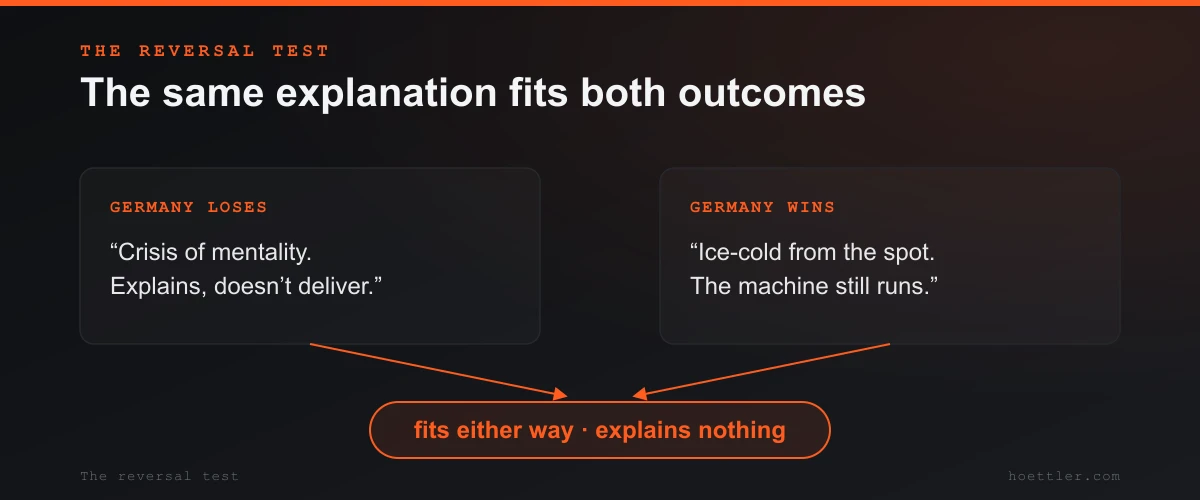
An explanation that fits victory and defeat equally well explains neither. It's unfalsifiable — and therefore free. It never commits in advance, it can never fail embarrassingly, it always appears only once the result is already on the scoreboard.
Explaining means: finding a story afterwards that fits. Understanding something means: committing beforehand and being able to be wrong.
Only the second is testable — and the second is exactly what almost every after-hours diagnosis of a nation's condition avoids.
Turning the lens on myself
Here's where the comfortable conclusion would be: "It's all just the narrative fallacy. Schreiber fell into a cognitive trap." But that would be precisely the same mistake in green.
"Narrative fallacy" is a skeleton key. You can swing it at any causal claim — at Schreiber's video as much as at this piece. A key that opens every door opens none. If my objection refutes everything, it refutes nothing. And the reader who feels superior after this critique, because they've seen through other people's cognitive trap, has merely fallen for the story on a more flattering level.
Nor is "I don't know" the humble endpoint it likes to dress up as. Radical doubt is as lazy as radical certainty — both spare you the work of deciding. A country still has to be governed. You still have to act without knowing the chain of causes. The goal isn't zero conviction. The goal is calibration: holding a belief exactly as firmly as the evidence supports it — and not one notch more. That applies to Schreiber's diagnosis just as much as to my skepticism about it.
Where Schreiber is right
And because I mean that: the strongest sentence in the whole video is the one that isn't about Paraguay at all.
Decline begins with getting used to it. You get used to delays, to slow authorities, to weak education scores — and at some point you call that habituation realism. That's a real, observable psychological mechanism, not a football metaphor. You see it in inflation, in declining product quality, in organizations that lower their standards step by step without noticing any single step.
What's striking: this thought needs no shootout. It stands on its own. It would be just as true after a win as after a loss — and that is the difference between an observation and a narrative. The football is the decoration. The habituation is the idea. Schreiber's best point is, of all things, the one he dressed up least as a story.
Three questions for any compelling explanation
You don't need to run time series for this. Three questions are enough to separate a good story from a good explanation:
- Does it predict anything? Does it commit to something that hasn't happened yet — or does it only explain, backwards, what's already fixed?
- Does it survive the reversal test? Would the opposite outcome have gotten the same explanation? If so, it explains nothing.
- Does it cost the teller anything? A real prediction can fail embarrassingly — that's its price and its value (Taleb calls it skin in the game). An after-hours diagnosis costs nothing. Which is why there's so much of the one and so little of the other.
What's left at the end
Millions of people watch this video and instantly feel: Yes. That's exactly how it is. That feeling is the actual product. And the eerie part: it feels exactly the same whether the story is true or false. The click of recognition carries no information whatsoever about the truth.
Maybe Constantin Schreiber is right. Maybe he isn't. The honest stance is to hold both at once: the diagnosis could be true — and the fact that it feels so compelling is still no proof. Both sentences together.
Intellectual honesty doesn't consist of finding the better story. Nor of retreating into "I don't know." It consists of holding a belief exactly as firmly as the evidence supports it — with Schreiber, and with this piece.
I packed the practice of exactly this kind of thinking into a small tool — Against Certainty, a field guide for thinking under uncertainty, with interactive mini-calculators instead of theory. Because the most expensive mistake isn't being wrong. It's turning a good feeling into a confident belief.